
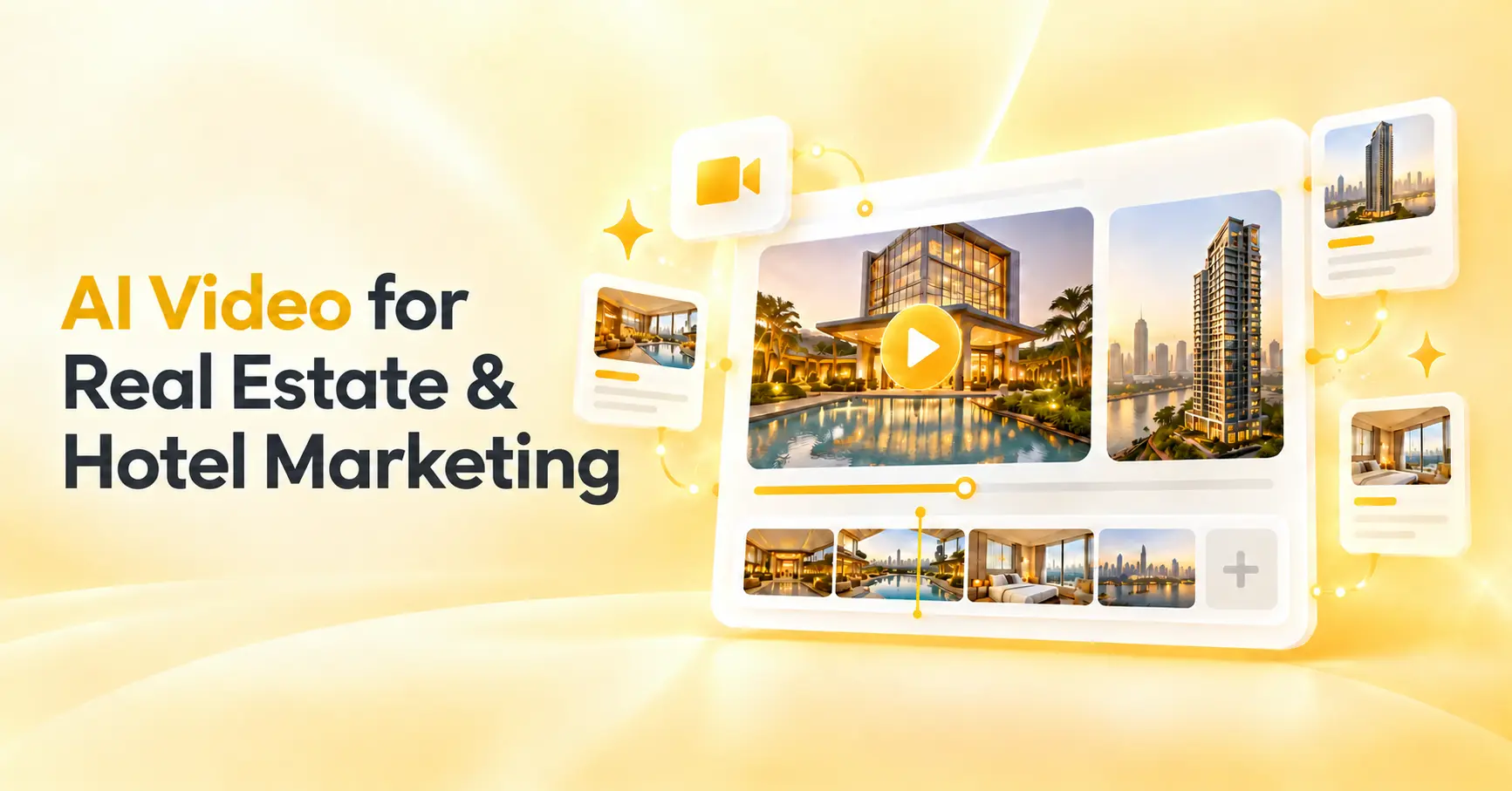
Explore how AI video is transforming real estate and hotel marketing in Thailand, from property walkthroughs to hotel room tours and faster content creation.

Suncorp AI Search Optimization
AI Growth Solutions, Bangkok
A condo listing with a static floor plan and six photos sits on the market for months. The same unit, shown in a 40-second walkthrough video that starts at the building entrance and ends with the balcony view, gets shortlisted by a buyer who never sets foot in Bangkok until the signing. AI video for real estate and hotel marketing is changing how properties are presented, helping buyers picture the experience before they ever visit. Video isn’t a nice-to-have for real estate and hospitality anymore — it’s the difference between a property a buyer can actually picture living in and one they scroll past. What’s changed in the last two years is who can afford to make that video, and how fast.
This guide covers what AI-generated and AI-enhanced video can actually do for real estate agencies and hotels in Thailand today, where it’s genuinely useful versus where it’s a gimmick, the disclosure line that matters for buyer trust, and a practical checklist for a team trying it for the first time — not a generic “AI is changing marketing” overview.
Suncorp AI Growth Solutions runs an AI Video practice built around exactly this kind of visual, decision-stage content, alongside its AI Search Optimization and AI Content work — this piece draws on that production experience directly, not secondhand research.

A buyer choosing a mattress or a phone case has near-zero regret risk — if it’s wrong, they return it. A buyer choosing a property, or a traveler choosing where to spend the only week of the year they get to take a trip, is making a decision with real financial and emotional stakes and almost no way to undo it. Video closes a gap that photos and text can’t: it shows scale, light, sound, and flow — whether a living room actually feels open, whether a hotel pool area is quiet or backs onto a busy road — the details a buyer or traveler most wants confirmed before committing.
That stakes-and-irreversibility combination is also exactly why both categories are unusually exposed to AI search the way our guide to GEO vs SEO describes: a prospective buyer or traveler increasingly asks an AI assistant to narrow the field before they ever watch a video, which means the video itself needs to exist somewhere structured enough for a model to know it’s there and what it shows.
“AI video” covers a wider range of real, working techniques than the phrase suggests, and conflating them is where most confusion starts:
None of these replace a real site visit or a real camera crew outright — they replace the parts of the production process (multi-language versions, footage cleanup, filling a gap where no fresh footage exists yet) that used to require a budget most individual listings or single-property hotels never had. Suncorp’s own AI Video service runs on exactly this split — real footage first, AI handling the parts that used to require a bigger crew or budget.

A property buyer’s journey has a shortlisting stage and a decision stage, and AI video earns its place differently at each. At shortlisting, an AI-assembled walkthrough from existing photos lets an agency cover a property the same week it’s listed, instead of waiting for a videographer’s schedule — speed matters more than production polish when a buyer is comparing a dozen options. At the decision stage, once a buyer is seriously considering one or two properties, AI-enhanced real footage — the actual unit, actual building, actual view, cleaned up rather than synthesized — does more to close the deal than a walkthrough with any AI-generated elements, because a serious buyer’s next question is usually “can I see the real thing,” and a video built on real footage answers that question consistently instead of contradicting itself at the site visit.
Multi-language voiceover matters more here than in almost any other property market: a meaningful share of Bangkok, Phuket, and Chiang Mai property buyers are international, and a walkthrough narrated only in Thai (or only in English) quietly excludes whichever audience it wasn’t made for.
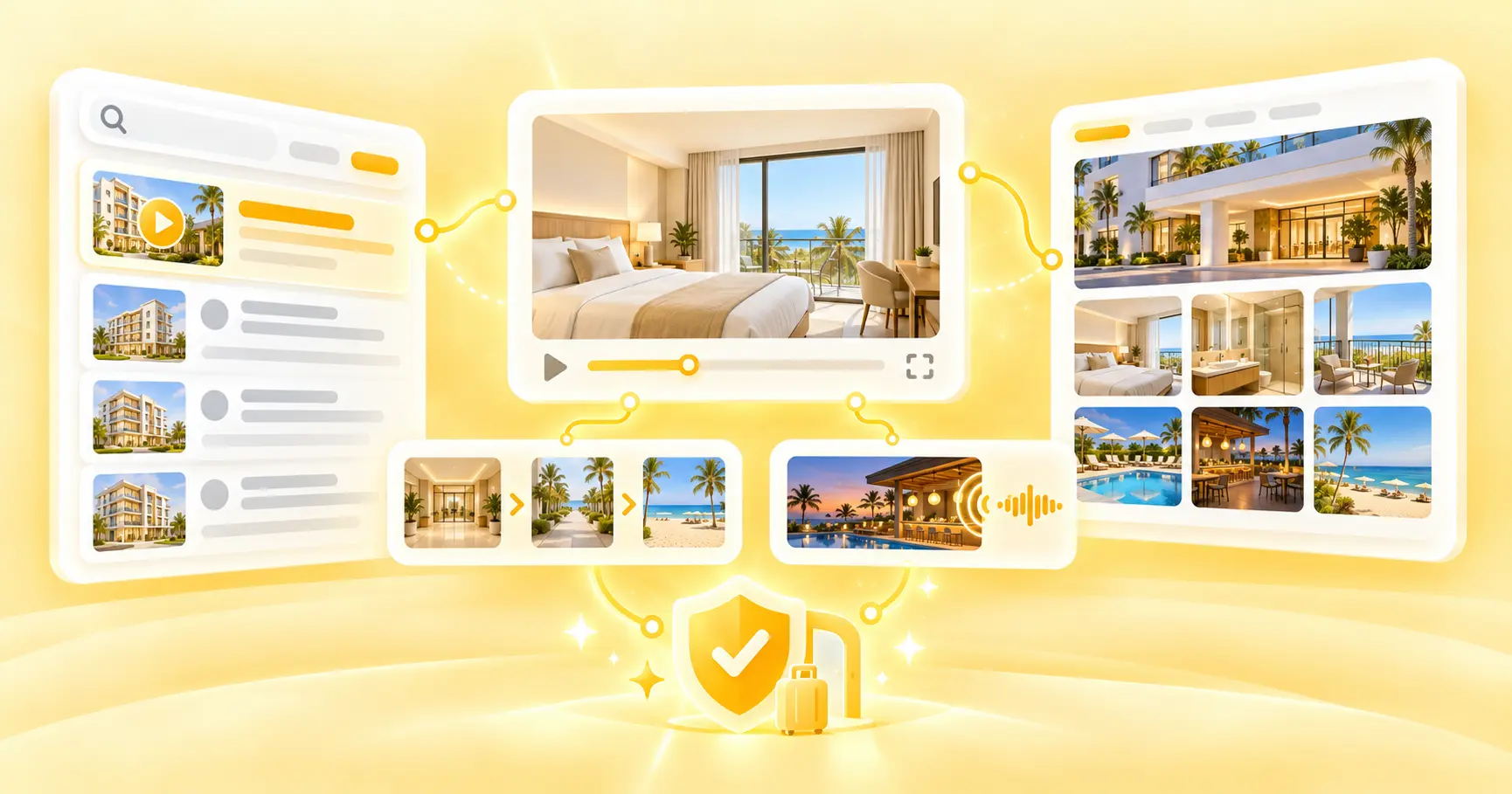
Hotels face a related but distinct problem, covered from the AI-search side in our AEO for hotels guide: a traveler asking an AI assistant which hotel to book is making a decision sight-unseen, often from another country, and video is the closest substitute for actually walking the property before arrival. A short, honest room-tour video — the actual room a guest will get, not a styled suite two categories above what most guests book — does more for pre-arrival confidence than a professionally lit hero shot that sets expectations the real room can’t match.
The same OTA-versus-own-site split that guide covers applies to video: OTA platforms increasingly support short video in listings, which reaches a browsing traveler, but a hotel’s own site is still the only place to show something an OTA template doesn’t have room for — a specific view from a specific room category, the actual walk from lobby to beach, the noise level near the pool bar at 6pm. That’s the differentiating detail a generic AI-generated hotel-lobby scene can’t provide, because it was never filmed at your actual property — the same reason this guide draws on Suncorp.
This is the section generic AI-marketing advice skips, and it’s the one with real consequences for real estate and hospitality specifically. The dividing line isn’t “did AI touch this video” — nearly every video will have AI involved somewhere in the pipeline now. The line is does the video show something that doesn’t exist, or represent something inaccurately:
Getting this line right isn’t just an ethics position — it’s a business one. A property or room that’s oversold in video and undersold in person generates worse reviews, and those reviews follow the listing for years.

Using a fully AI-generated scene for a property’s hero video. The single fastest way to generate a mismatch complaint at site visit or check-in — save generative scenes for early-stage concept marketing on properties not yet built, where the “rendering” framing is already the industry norm.
Skipping multi-language voiceover because it “used to be expensive.” This is now one of the cheapest additions in the entire AI video pipeline and the one most directly tied to reaching an international buyer or traveler.
Treating video as a one-time asset instead of updating it. A room tour from a renovation two years ago, or a listing video for a unit that’s since been sold, actively misleads — the same “keep operational facts current” discipline the hotel AEO checklist covers applies to video, not just text.
No captions or transcript. Beyond accessibility, a video with no text signal is invisible to the same retrieval mechanisms covered in this site’s other GEO guides — the visual content might be excellent and still never get cited or surfaced.
Assuming AI video replaces the site visit or the sales conversation entirely. It gets a buyer or traveler to the shortlist faster; it doesn’t close the deal on its own, and treating it as the whole strategy leaves the actual decision-stage conversation under-resourced.
Suncorp AI Growth Solutions is a Bangkok-based agency building AI Search Optimization (GEO/AEO), AI Advertising, and AI Content services specifically for the Thai and Southeast Asian market — video production and multi-language voiceover for real estate and hospitality clients runs through the same AI Video and AI Content Studio practice this guide draws on, and pairing that video with AI Advertising campaigns keeps the paid and organic story consistent for the same property.
AI video doesn’t change what makes real estate and hotel marketing work — showing a buyer or traveler the truth about a space, fast enough to matter and honestly enough to hold up at the actual visit. What’s changed is that a small agency or a single independently owned hotel can now afford the multi-language, frequently updated video content that used to require an enterprise production budget. The properties and hotels that treat this as a tool for showing real spaces more clearly — not for showing spaces that don’t exist — are the ones that turn video views into shortlisted properties and shortlisted properties into bookings.
Only if it misrepresents something real — a fully generated room or view that doesn’t exist, shown without disclosure, is the risk case. AI-enhanced real footage, where the property and view are genuinely accurate, isn’t a disclosure issue any more than photo color-correction has ever been.
Both, but only if it’s structured to be found — captions, a transcript, and basic video schema matter as much as the footage itself for a video to surface in AI-generated answers, the same retrieval mechanics covered in this site’s other AI search guides.
AI-enhanced real footage plus multi-language voiceover on existing content — no disclosure complexity, immediate reach into a broader audience, and no need for new footage to be shot first.
Both, but for different jobs — OTA video reaches a browsing traveler at the comparison stage; a hotel’s own site is where the specific, differentiating detail an OTA template has no room for actually gets shown.
Whenever the thing it shows changes — a renovation, a sold unit, a seasonal amenity closure — the same “keep operational facts current” standard that applies to text applies to video, and outdated video does more damage to trust than no video at all.
Often yes on the multi-language and update-frequency dimensions specifically — a smaller operation can turn around an updated, accurately narrated video faster than a large chain’s approval process, which is exactly the kind of agility AI tooling makes practical at a small-business budget.
A team already comfortable with basic video editing tools can handle AI-enhanced footage and voiceover in-house. A business wanting the full pipeline — production, multi-language versions, the schema and captioning work that makes it retrievable by AI search, and paid distribution — typically moves faster with a partner running all three together. If you want a straightforward read on where to start, book a free AI visibility consultation and we’ll walk through it.

Suncorp AI Growth Solutions is a Bangkok-based agency building AI Search Optimization (GEO/AEO), AI Advertising, and AI Content services specifically for the Thai and Southeast Asian market — the video production and multi-language work this guide describes runs through the same AI Video practice we operate for real estate and hospitality clients directly.
Get a free, scored AI Visibility report in about two minutes
— no commitment required.
September 25, 2026
September 18, 2026

